The EU AI Act Is Already Here. Your Company May Already Be Exposed.
Introducing the EU AI Act Signal Intelligence Platform: an executive AI governance command center powered by specialized agents that detect Shadow AI, classify risk, expose compliance gaps, and prepare your organization before regulators, auditors, clients, employees, or crisis reveal what leadership did not see.
Most companies do not have an AI governance problem because they are using advanced AI. They have a governance problem because they are using unmanaged AI. Employees are already using ChatGPT, Copilot, Gemini, automation tools, AI-powered CRMs, recruitment systems, marketing generators, analytics platforms, and vendor AI features without full visibility, documentation, human oversight, or risk classification.
The greatest AI risk is not AI itself. It is invisible AI operating without leadership control.
Critical Exposure
Non-Compliant Risk
Critical Gap
High Exposure
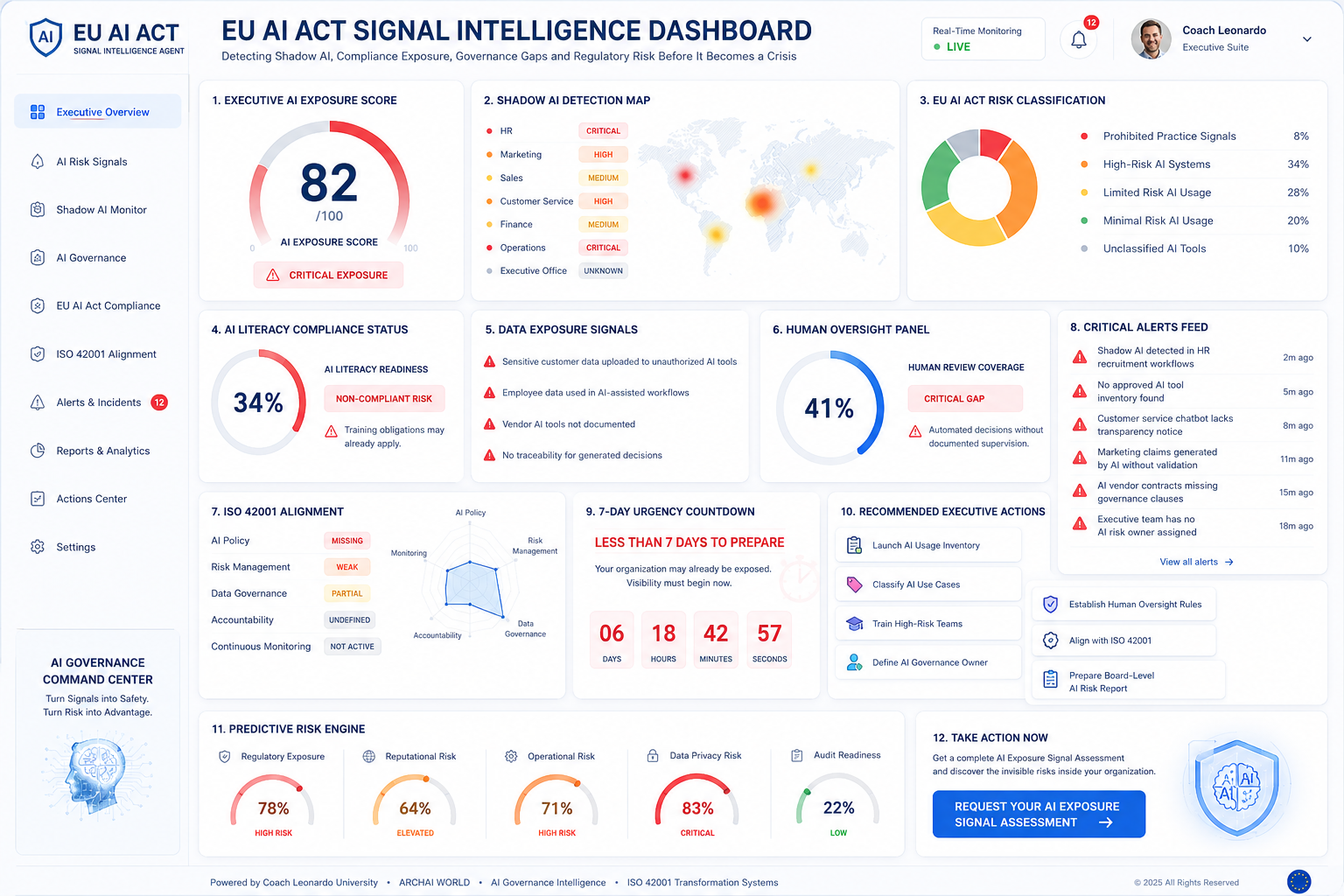
This Is Not Consulting. This Is AI Governance Signal Intelligence.
Traditional consultancy waits for interviews, workshops, documents, committees, and manual assessments. Our agent-powered model creates a living AI governance intelligence layer that detects signals, classifies risks, and turns exposure into executive action.
Consultants normally ask, "What AI are you using?" The problem is that most organizations do not know. Our system starts from the reality of 2026: AI is already inside the enterprise, often hidden in workflows, tools, vendors, teams, and individual behaviors.
Why Now?
The EU AI Act is no longer a future concern. AI literacy obligations, prohibited practices, governance expectations, transparency, documentation, human oversight, and risk classification are already becoming operational responsibilities.
Waiting is no longer strategy. Waiting is exposure.
The Specialized Agents Working Behind The Dashboard
Each agent performs a different executive intelligence function. Together, they create a governance operating system for EU AI Act readiness, ISO 42001 alignment, enterprise architecture, change management, and crisis response.
Shadow AI Detector
Finds unauthorized, undocumented, or invisible AI usage across departments, tools, vendors, workflows, and employee behaviors.
EU AI Act Classifier
Classifies AI use cases into prohibited, high-risk, limited-risk, minimal-risk, and unclassified categories.
AI Governance Advisor
Detects missing policies, ownership gaps, weak accountability, lack of approvals, and governance immaturity.
ISO 42001 Alignment Agent
Maps signals to AI Management System readiness, risk management, controls, monitoring, and continuous improvement.
Human Oversight Agent
Identifies workflows where AI influences decisions without documented review, accountability, or intervention rules.
Executive Signal Advisor
Translates technical findings into boardroom language: risk, impact, urgency, accountability, and decisions.
Data Exposure Agent
Detects sensitive data risks, employee data exposure, client data leakage, vendor uncertainty, and privacy vulnerabilities.
AI Literacy Agent
Measures whether teams are trained according to their roles, tools, exposure level, and regulatory responsibility.
Remediation Architect
Creates a 30, 60, and 90-day roadmap for visibility, governance, training, risk classification, and board reporting.
The Dashboard: Your EU AI Act Command Center
A clear, executive-ready view of the signals that matter before they become regulatory, reputational, operational, or legal problems.
AI Exposure Score
Instant executive view of organizational exposure.
Shadow AI Map
Departments ranked by invisible AI activity and unmanaged usage.
Risk Classification
EU AI Act categories translated into practical business risk.
Critical Alerts Feed
Real-time warnings for high-impact governance failures.
AI Literacy Status
Training readiness and workforce risk visibility.
Human Oversight Panel
Identifies automated decisions without supervision.
ISO 42001 Alignment
Tracks policy, controls, accountability, and monitoring maturity.
Predictive Risk Engine
Forecasts regulatory, reputational, operational, privacy, and audit exposure.
The Only Offer Combining Agents, Dashboard, Change Management, And Crisis Lab
Most AI governance offers stop at policies. We go further. We prepare the organization psychologically, operationally, architecturally, and strategically.
Inspired by the intensity of an "Architect in Fire" scenario, our EU AI Act Crisis Lab simulates the moment when leadership discovers unmanaged AI exposure: HR using AI without controls, customer data uploaded to public tools, marketing claims generated without validation, no AI owner, no inventory, no training evidence, and no board-level response plan.
EU AI Act Crisis Lab Includes:
- Executive crisis simulation
- Shadow AI discovery scenario
- Regulatory exposure boardroom exercise
- AI incident response rehearsal
- Change management intervention plan
- Leadership alignment workshop
- Communications and accountability protocol
- Decision-making under AI governance pressure
Offer Structure & Investment Levels
Choose the level of readiness your organization needs now. The platform can start as an assessment, evolve into a command center, and scale into an enterprise AI governance operating system.
AI Signal Scan
- AI exposure assessment
- Shadow AI discovery
- AI inventory snapshot
- Executive exposure score
- Basic dashboard view
- AI risk heatmap
- Executive PDF report
AI Governance Command Center
- Complete dashboard setup
- Specialized agent ecosystem
- EU AI Act use-case classification
- AI policy and governance framework
- Human oversight model
- AI literacy readiness plan
- Executive advisory sessions
- EU AI Act Crisis Lab
AI Act Enterprise Transformation
- Enterprise AI governance operating model
- ISO 42001 implementation alignment
- Enterprise architecture integration
- Board AI readiness program
- AI governance office design
- Advanced dashboard customization
- Change management transformation
- Full crisis lab and executive simulation
AI Governance as a Service
- Continuous monitoring
- Quarterly AI risk audits
- Regulatory updates
- Executive reports
- Governance coaching
- AI literacy refresh
Licensing & White Label
- White-label agent framework
- Dashboard methodology
- Templates and playbooks
- Partner certification
- AI Governance Academy
- Consulting partner enablement
Who This Is For
- CEOs and founders who need AI visibility before exposure becomes crisis
- CIOs, CTOs, CAIOs, and digital transformation leaders
- Enterprise architects responsible for AI operating models
- Compliance, risk, legal, privacy, and governance teams
- HR leaders using AI in recruitment, screening, or productivity analysis
- Government, banking, healthcare, insurance, education, and regulated sectors
What You Receive
- AI use-case inventory
- Shadow AI exposure map
- EU AI Act risk classification
- AI literacy readiness assessment
- Human oversight gap analysis
- Data exposure signal report
- ISO 42001 alignment roadmap
- Executive dashboard
- Board-level AI risk report
- 30, 60, and 90-day remediation plan
Request Your AI Exposure Signal Assessment
Discover the invisible AI risks already operating inside your organization before regulators, auditors, competitors, employees, customers, or crisis expose them first.